
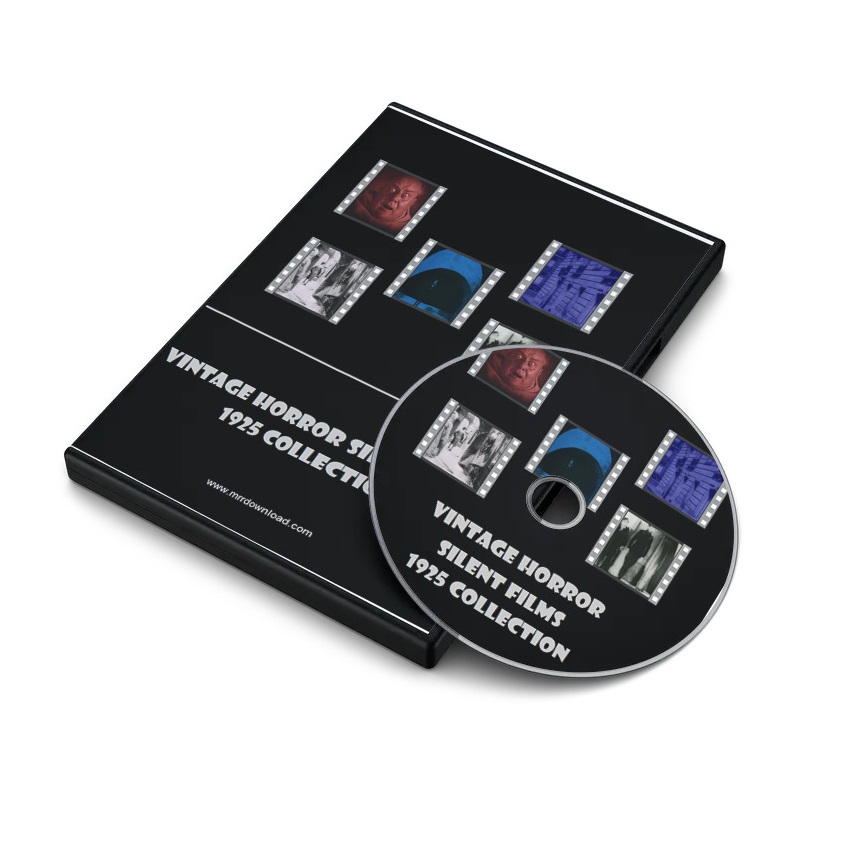
Vintage Horror Silent Films 1920’s Collection
These rare vintage horror silent films are excellent for making presentations, advertisements, historical extracts, video projects and much more plus they are fun to watch! Download these rare silent films of yesterday today!
Description
VINTAGE HORROR SILENT FILMS COLLECTION – 1920’s RECORDINGS
5 Films, RARE Collections in MP4 and AVI File Formats
These vintage films are excellent for general viewing, nostalgic viewing, making presentations, advertisements, historical extracts, video projects and much more!
5 Vintage Silent Horror Films

1. Genuine (1920) – is a 1920 German silent horror film directed by Robert Wiene. It was also released as Genuine: A Tale of a Vampire. Director Wiene created Genuine as a follow-up to his massively successful 1919 film The Cabinet of Dr. Caligari, using the same writer and cinematographer who had worked on the earlier film. Production designer Cesar Klein even returned to contribute his bizarre Caligari-like imagery to the film. Genuine is not actually a vampire in the film, but rather a vamp (succubus) who uses her powers of seduction to torment and control the men who love her. There is a bit of surprising nudity in the slave market sequence. The plot utilizes the old it was all just a dream-type ending, as the proceedings are revealed to be a dream suffered by a man who falls asleep while reading a scary book. Genuine was edited down into a 43-minute condensed version, which is the cut that has most commonly been available, making it very hard to judge the film.
2. Haxan (1922) – is a 1922 silent horror essay film written and directed by Benjamin Christensen. Consisting partly of documentary-style storytelling as well as dramatized horror sequences, the film charts the historical roots and superstitions surrounding witchcraft, beginning in the Middle Ages through the 20th century. Based partly on Christensen’s own study of the Malleus Maleficarum, a 15th-century German guide for inquisitors, the film proposes the notion that such witch hunts may have stemmed from misunderstandings of diseases and mental illnesses, triggering mass hysteria. An international co-production between Sweden and Denmark, Haxan was filmed in 1920. With Christensen’s meticulous recreation of medieval scenes and the lengthy production period, the film was the most expensive Scandinavian silent film ever made, costing nearly two million Swedish kronor. Although it won acclaim in Denmark and Sweden, the film was banned in the United States and heavily censored in other countries for what were considered at that time graphic depictions of torture, nudity, and sexual perversion.
3. Les Vampires (1916) – is a 1915–16 French silent crime serial film written and directed by Louis Feuillade. Set in Paris, it stars Édouard Mathé, Musidora and Marcel Lévesque. The main characters are a journalist and his friend who become involved in trying to uncover and stop a bizarre underground Apache gang, known as The Vampires (who are not the mythological beings their name suggests). The serial consists of ten episodes, which vary greatly in length. Being roughly 7 hours long, it is considered one of the longest films ever made. It was produced and distributed by Feuillade’s company Gaumont. Due to its stylistic similarities with Feuillade’s other crime serials Fantômas and Judex, the three are often considered a trilogy. Fresh from the success of Feuillade’s previous serial, Fantômas, and facing competition from rival company Pathé, Feuillade made the film quickly and inexpensively with very little written script. Upon its initial release Les Vampires was given negative reviews by critics for its dubious morality and its lack of cinematic techniques compared to other films. However, it was a massive success with its wartime audience, making Musidora a star of French cinema. The film has since come under re-evaluation and is considered by many to be Feuillade’s magnum opus and a cinematic masterpiece. It is recognised for developing thriller techniques, adopted by Alfred Hitchcock and Fritz Lang, and avant-garde cinema, inspiring Luis Buñuel and others.
4. Nosferatu: A Symphony of Horror (1922) – is a 1922 silent German Expressionist horror film directed by F. W. Murnau and starring Max Schreck as Count Orlok, a vampire with an interest in both a new residence and the wife (Greta Schröder) of his estate agent (Gustav von Wangenheim). The film is an unauthorized and unofficial adaptation of Bram Stoker’s 1897 novel Dracula. Various names and other details were changed from the novel, including Count Dracula being renamed Count Orlok. It has long been repeated that these changes were implemented in an attempt to avoid accusations of copyright infringement. However, this seems unlikely as the original German intertitles explicitly state that the film is based on the Bram Stoker novel. Film historian David Karat states in his commentary track for the film that “No source has ever documented” this claim and that since the film was “a low-budget film made by Germans for German audiences… setting it in Germany with German named characters makes the story more tangible and immediate for German speaking viewers”. Even with several details altered, Stoker’s heirs sued over the adaptation, and a court ruling ordered all copies of the film to be destroyed. However, a few prints of Nosferatu survived, and the film came to be regarded as an influential masterpiece of cinema.
5. The Cabinet of Dr. Cagliari (1920) – is a 1920 German silent horror film, directed by Robert Wiene and written by Hans Janowitz and Carl Mayer. Considered the quintessential work of German Expressionist cinema, it tells the story of an insane hypnotist (Werner Krauss) who uses a somnambulist (Conrad Veidt) to commit murders. The film features a dark and twisted visual style, with sharp-pointed forms, oblique and curving lines, structures and landscapes that lean and twist in unusual angles, and shadows and streaks of light painted directly onto the sets. The script was inspired by various experiences from the lives of Janowitz and Mayer, both pacifists who were left distrustful of authority after their experiences with the military during World War I. The film makes use of a frame story, with a prologue and epilogue which, in a twist ending, reveals the main narrative is actually the delusion of a madman. Janowitz has claimed this device was forced upon the writers against their will. The film’s design was handled by Hermann Warm, Walter Reimann and Walter Röhrig, who recommended a fantastic, graphic style over a naturalistic one. The film thematizes brutal and irrational authority. Writers and scholars have argued the film reflects a subconscious need in German society for a tyrant, and is an example of Germany’s obedience to authority and unwillingness to rebel against deranged authority. Some critics have interpreted Caligari as representing the German war government, with Cesare symbolic of the common man conditioned, like soldiers, to kill. Other themes of the film include the destabilized contrast between insanity and sanity, the subjective perception of reality, and the duality of human nature.
*Description source: Wikipedia



Reviews
There are no reviews yet.