


Vintage Films And Footage Pre-1910 Recordings
These rare vintage films and footage are excellent for making presentations, advertisements, historical extracts, video projects and much more plus they are fun to watch! Download these films today!
Description
VINTAGE FILMS AND FOOTAGES PRE-1910 RECORDINGS
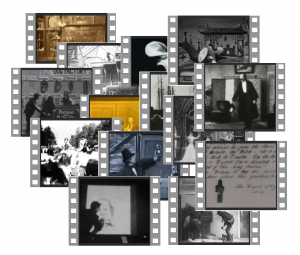
14 Films and Footages, RARE Collections in MP3 and AVI File Formats
These vintage films and footages are excellent for making presentations, advertisements, historical extracts, video projects and much more!
14 Vintage Silent Films and Footage
1. A Christmas Carol (1910) – is a silent drama film directed by J. Searle Dawley and produced at Edison Studios in The Bronx in New York City. After the 1901 British release Scrooge, or, Marley’s Ghost, this American version of Charles Dickens’ 1843 novella is the second oldest surviving screen adaptation of the famous literary work. It features Marc McDermott as Ebenezer Scrooge and Charles S. Ogle as Bob Cratchit.
2. A Trip to the Moon (1902) (French: Le Voyage dans la Lune) – is a French adventure short film directed by Georges Méliès. Inspired by a wide variety of sources, including Jules Verne’s 1865 novel From the Earth to the Moon and its 1870 sequel Around the Moon, the film follows a group of astronomers who travel to the Moon in a cannon-propelled capsule, explore the Moon’s surface, escape from an underground group of Selenites (lunar inhabitants), and return to Earth with a captive Selenite. It features an ensemble cast of French theatrical performers, led by Méliès himself in the main role of Professor Barbenfouillis, and is filmed in the overtly theatrical style for which Méliès became famous.
3. Crissie Sheridan Serpentine Dance (1897) – A woman in a white gown performs a skirt dance, using her arms to produce circles and other patterns within the folds of her costume. Her legs and feet appear to be bare.” It comes out of the Edison Company in 1897, by which time they’d been producing movies like these for at least three years. It appears likely that this would have been produced for the Kinetoscope – intended to be watched individually through a machine with a crank in a parlor or arcade-type setting. The fact that it can be played as an endless loop, starting from any point would be advantageous, because the proprietor didn’t have to worry if a given customer stopped it before its “ending” and the next person picked it up.
4. Dog Factory (1904) – A brief vaudeville-style demonstration of a “Dog Transformator,” a machine that instantly turns dogs into sausages, and amazingly, sausages back into dogs.
5. Frankenstein (1910) – is a an American short silent horror film produced by Edison Studios. It was directed by J. Searle Dawley, who also wrote the one-reeler’s screenplay, broadly basing his “scenario” on Mary Shelley’s 1818 novel Frankenstein; or, The Modern Prometheus. This short motion picture is generally recognized by film historians as the first screen adaptation of Shelley’s work. The small cast, who are not credited in the surviving 1910 print of the film, includes Augustus Phillips as Dr. Frankenstein, Charles Ogle as Frankenstein’s monster, and Mary Fuller as the doctor’s fiancée.
6. Galveston Hurricane and Tidal Wave (1900) – A short video footage of the Great Galveston hurricane, known regionally as the Great Storm of 1900, was the deadliest natural disaster in United States history and the fifth-deadliest Atlantic hurricane overall.
7. Robbery Under Arms (1907) – is an Australian silent western/drama film based on the 1888 novel by Rolf Boldrewood about two brothers and their relationship with the bushranger Captain Starlight. It was the first film version of the novel and the third Australian feature ever made.
8. Scrooge, or, Marley’s Ghost (1901) – is a British short silent drama film, directed by Walter R. Booth, featuring the miserly Ebenezer Scrooge (played by Daniel Smith) confronted by Jacob Marley’s ghost and given visions of Christmas past, present, and future. It is the earliest known film adaptation of Charles Dickens’s 1843 novella A Christmas Carol. The film, “although somewhat flat and stage-bound to modern eyes,” according to Ewan Davidson of BFI Screenonline, “was an ambitious undertaking at the time,” as, “not only did it attempt to tell an 80 page story in five minutes, but it featured impressive trick effects, superimposing Marley’s face over the door knocker and the scenes from his youth over a black curtain in Scrooge’s bedroom.”
9. Tchin Chao the Chinese Conjurer (1904) – Le Thaumaturge chinois, sold in the United States as Tchin-Chao, the Chinese Conjurer and in Britain as The Chinese Juggler, is a 1904 French short silent film by Georges Méliès. It was sold by Méliès’s Star Film Company and is numbered 578–580 in its catalogues. Méliès plays the conjurer of the title; his tricks are worked using substitution splices and dissolves. The motion in the film is noticeably fast, even at silent-film speeds such as 16 frames per second; Méliès may have had his camera operator deliberately undercrank the camera to create a stylized effect.
10. The Devil and the Statue (1901) – A magnificent Venetian oratory. On the left a large bay window through which may be seen the Grand Canal of the city of Venice. In the centre a colonnade and a hemicycle; to the right is a statue of the Madonna. At the beginning of the scene Romeo in his gondola sings to Juliet a sentimental song, then goes away. Hardly has he departed when the colonnade falls to pieces, disclosing the devil. Juliet, frightened, runs to the window and calls Romeo. The latter attempts to enter and protect his fiancée, but at a gesture from the devil the window is instantly covered with a grating and Romeo makes frantic efforts to break it. The devil begins to dance a wild dance before Juliet, who is beside herself from terror. The devil gradually becomes the size of a giant (a novel effect). Juliet implores the statue of Madonna, which becomes animated, descends from its pedestal, and stretching out its arms orders the devil to disappear. The devil grows smaller and smaller and finally becomes a tiny.
11. The Great Train Robbery (1903) – is an American silent short Western film made by Edwin S. Porter for the Edison Manufacturing Company. It follows a gang of outlaws who hold up and rob a steam locomotive at a station in the American West, flee across mountainous terrain, and are finally defeated by a posse of locals. The short film draws on many sources, including a robust existing tradition of Western films, recent European innovations in film technique, the play of the same name by Scott Marble, the popularity of train-themed films, and possibly real-life incidents involving outlaws such as Butch Cassidy.
12. The Enchanted Drawing (1900) – is a silent film directed by J. Stuart Blackton. It is best known for containing the first animated sequences recorded on standard picture film, which has led Blackton to be considered the father of American animation.
13. The Magician (1900) – is an American silent film produced by Thomas A. Edison’s Edison Manufacturing Company. According to the Edison film catalog, the film originally was sold to theaters for $9.00. This film exemplifies the strong links between early film and magic; the 1900 Edison film catalog alone contained several trick films, including Ching Ling Foo Outdone, The Clown and the Alchemist, Congress of Nations and Hooligan Assists the Magician.
14. The Wizard of Oz (1910) – is an American silent fantasy film and the earliest surviving film version of L. Frank Baum’s 1900 novel The Wonderful Wizard of Oz, made by the Selig Polyscope Company without Baum’s direct input. It was created to fulfill a contractual obligation associated with Baum’s personal bankruptcy caused by The Fairylogue and Radio-Plays, from which it was once thought to have been derived. It was partly based on the 1902 stage musical The Wizard of Oz, though much of the film deals with the Wicked Witch of the West, who does not appear in the musical.
*Description source: Wikipedia and other Public Domain websites.



Reviews
There are no reviews yet.